
The "Pseudo-Correlation" Trap in Thematic ETFs – Does an AI ETF Truly Represent Memory?
AI storage and computing power are two sides of the same hardware story. GPUs, accelerators, and custom AI chips get most of the attention, but without DRAM, HBM, and fast storage, they simply stall. It is therefore tempting to assume that any AI ETF—or semi ETF marketed as “AI exposure”—automatically represents memory. After all, if the fund moves with AI cycles, and AI cycles require memory, isn’t that enough?

That assumption is where the "pseudo correlation" trap lives. An ETF can be highly correlated with AI memory indicators over a given period yet still be structurally underexposed to memory as an asset. Correlation alone can create the illusion of representation. In reality, the index underlying an AI ETF may overweight compute, underweight memory, and treat storage capacity as a secondary driver. For investors using ETFs or index derivatives to capture AI storage and computing power, distinguishing true representation from pseudo correlation is essential.
What Pseudo Correlation Means in AI ETFs
Pseudo correlation is a situation where two instruments move together—not because they share the same exposure, but because they respond to a common narrative or macro driver. In AI hardware, a general AI ETF and a memory ETF may both rise when the market is optimistic about AI. Their returns can appear highly correlated. But that does not mean the AI ETF actually represents memory in its composition.
Several things can cause pseudo correlation in AI ETFs:
- Shared macro drivers: Both compute and memory stocks respond to AI capex headlines and risk-on sentiment.
- Sector-wide flows: Investors buying “AI” may push up all semi-related ETFs, regardless of their internal weightings.
- Short data windows: Over a limited time period, correlations can look strong even when structural exposures differ.
The trap comes from assuming that because an AI ETF has moved alongside memory or AI storage indicators recently, it must be structurally representative of memory going forward. That is not necessarily true.
Why Many AI ETFs Systematically Underweight Memory

Most AI and semi ETFs are built on indices that were not originally designed as “AI storage” products. They are often cap‑weighted or modified cap‑weighted versions of broader semiconductor or tech benchmarks. That leads to systematic memory underweighting:
- Market-cap bias: Logic and compute companies often have larger market caps than pure memory makers, so cap-weighted indices skew toward compute.
- Narrative bias: Index design processes frequently prioritize well-known AI chip designers over less glamorous memory suppliers.
- Legacy sector definitions: Indices based on old chip classifications treat memory as one subsector among many, not as a central AI constraint.
An AI ETF built on such indices can have significant exposure to compute and almost incidental exposure to memory. Yet in market commentary, it may still be described as “hardware AI exposure,” giving investors the impression that both compute and storage are equally represented. That is pseudo correlation in narrative form.
Correlation vs Composition: Two Different Questions
The key distinction for investors is this:
- Correlation asks: Do the ETF’s returns move with AI memory indicators?
- Composition asks: How much of the ETF’s weight is actually in memory and storage companies?
An AI ETF can have high correlation with memory indicators purely because the whole sector is moving in response to AI expectations. But if memory firms make up a small percentage of the ETF’s holdings, then the fund is not structurally representative of memory. Its returns are driven by compute and other components, and memory’s share of risk and reward is limited.
True representation requires both correlation and composition. Pseudo correlation provides the first and glosses over the second.
Indicators That an AI ETF Is Only Pseudo-Representing Memory
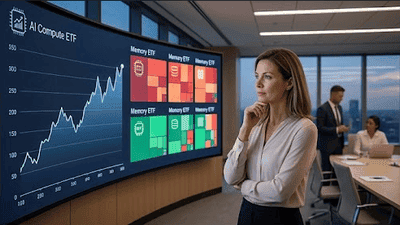
There are several practical signs that an AI ETF may be caught in the pseudo correlation trap when it comes to memory:
- Low memory weight: Memory and HBM producers make up a small slice of holdings, despite memory being central to AI hardware.
- Index documentation: The index methodology emphasizes compute, logic, or broad tech themes without specific memory considerations.
- Performance drivers: Major performance events correspond to compute-related news, while memory-specific events only lightly move the ETF.
If these indicators are present, then even a strong correlation with memory prices or DRAM indices over a recent period may be misleading. The ETF is riding the same sentiment wave, not representing the same underlying exposure.
Why This Matters for AI Storage and Computing Power Strategies
For investors specifically targeting AI storage and computing power, representation matters. If you want to capture the memory bottleneck, relying on pseudo-correlated AI ETFs can leave you underexposed. You may think you are investing in the full AI hardware stack, while in reality you are overweight compute and underweight storage.
This has several consequences:
- Risk misalignment: Your portfolio may be more vulnerable to compute-specific shocks than to memory shocks, despite memory being a critical constraint.
- Missed opportunities: When memory cycles outperform due to HBM shortages or DRAM pricing, pseudo-correlated AI ETFs may not fully participate.
- Hedging inefficiency: Using an AI ETF as a proxy hedge for memory exposure may not work well, because the hedge is structurally skewed toward compute.
If the objective is “AI storage and computing power,” then pseudo correlation is not enough. You need to actively ensure memory is properly represented.
Active Correction: How to Avoid the Trap

Avoiding the pseudo correlation trap requires moving beyond return charts and into holdings and index rules. Some practical steps:
- Inspect holdings: Look at the percentage of memory-related companies in your AI ETFs. If it is small, do not assume memory is well represented.
- Supplement with memory ETFs: Consider adding dedicated memory or HBM ETFs as overlays on top of AI compute ETFs to increase true memory exposure.
- Create dual sleeves: Treat AI hardware as two explicit sleeves—compute and storage—and allocate to each separately via appropriate ETFs and derivatives.
By consciously adding memory exposure, you convert pseudo correlation into genuine representation. The ETF mix now reflects the actual AI hardware stack more accurately rather than relying on a single compute-heavy index to do everything.
Index Derivatives: Where Pseudo Correlation Is Especially Dangerous
Pseudo correlation is particularly dangerous when using index derivatives—futures and options—linked to AI or semi indices. If you assume that a future on an AI ETF will behave like a memory proxy because of recent correlation, you might design hedges or levered trades that do not match actual memory risks.
For example:
- Using AI ETF futures to hedge memory price risk, when the index is heavily compute-weighted.
- Buying call options on an AI ETF as a way to express a view on HBM demand, even though memory names are a minor component.
Such strategies can behave unexpectedly when memory and compute decouple. TRUE memory-related indices or derivatives should be used when targeting AI storage. AI compute derivatives can complement those exposures, but should not be assumed to fully represent them.
When Correlation Does Help—But Only With Context
None of this means correlation is useless. It is still a helpful tool for understanding how AI ETFs and memory indicators behave in relation to each other. High correlation can signal that AI storage and compute are in a shared macro regime, which may influence timing and risk decisions.
Correlation can be used to:
- Identify periods when AI sentiment is broadly supportive for both compute and memory.
- Understand general co-movement patterns useful for risk models.
- Gauge how AI-themed ETFs respond to hardware cycles compared to pure memory indices.
But correlation should be paired with composition analysis, not substituted for it. It is a piece of the puzzle, not the entire picture.
Examples of True vs Pseudo Representation
To crystallize the distinction, consider two hypothetical AI hardware products:
- ETF A: An AI compute ETF with 70% GPU/accelerator exposure, 15% cloud hardware, 10% networking, 5% memory.
- ETF B: A balanced AI hardware ETF with 40% compute, 40% memory, 20% equipment/networking.
Both may be correlated with memory indicators over a given period. But ETF A is pseudo-representative of memory; its structural exposure is minimal. ETF B, by design, is truly representative, assigning memory a large share of index weight.
An investor seeking AI storage exposure should treat ETF A as primarily a compute tool and overlay memory, while ETF B could be used as a more integrated exposure. Pseudo correlation alone cannot tell you this; you must look at the underlying construction.
Investor Behavior: Recognizing and Adjusting
Over time, investor behavior tends to evolve as pseudo correlation traps are recognized. We can expect more practitioners to:
- Ask “what is actually in this ETF?” rather than “what has it moved alongside lately?”
- Separate AI storage and AI compute exposures in their asset allocation framework.
- Demand clearer thematic indices that explicitly balance memory and compute.
As this behavior evolves, ETF providers may respond with more refined AI hardware products—making representation explicit rather than implicit. Until then, the onus is on investors to avoid conflating correlation with composition.
Conclusion
The “pseudo correlation” trap in theoretical ETFs is subtle but significant. An AI ETF that moves with memory prices over a recent horizon may feel like a good proxy for AI storage. Yet if its index is structurally underweight memory, that relationship is largely sentimental, not structural. For investors focused on AI storage and computing power, this matters a great deal.
The remedy is not to abandon AI ETFs. It is to look under the hood, distinguish true representation from pseudo correlation, and actively correct memory underweighting through overlays, dual-sleeve allocations, or more balanced hardware products. In the AI era, where memory is increasingly the bottleneck, having ETFs and derivatives that genuinely reflect storage as well as compute is no longer a nice-to-have. It is central to building intelligent, theme-aligned portfolios that match the reality of the hardware powering AI.
You May Like

Narrowing Spread Between NAND Spot and Contract Prices in 2026 – A Signal
By 2026, one of the most watched metrics in the NAND flash market has started to shift in a subtle but meaningful way: the spread between spot prices and long‑term contract prices is narrowing. For casual observers, this may look like just another incremental change in a notoriously volatile industry. For memory makers, module houses, device OEMs, and data center buyers, however, a tightening gap between spot and contract prices is a signal—a reflection of evolving supply–demand balance, risk perceptions, and strategic behavior on both sides of the market.

Price Divergence Trading Strategies Between NAND Flash and DRAM ETFs
NAND flash and DRAM sit at the core of AI storage and computing power. Both are memory, but they are not the same business. DRAM is main memory—fast, volatile, and central to high‑bandwidth workloads like AI training and inference. NAND is non‑volatile storage—slower than DRAM, but crucial to persistent data and large‑scale object storage. The cycles that drive their pricing and margins overlap, yet they often diverge. That divergence is where trading strategies between NAND and DRAM ETFs become interesting.

China’s HBM Localization Progress: The Catch-Up Pace of CXMT and XMC
China’s drive to localize advanced memory technologies has accelerated over the past several years. High-Bandwidth Memory (HBM) sits near the center of that strategy because it is integral to AI accelerators, high-performance computing (HPC) and other strategic compute platforms. Two domestic players—ChangXin Memory Technologies (CXMT) and XMC (Xianghui Memory, commonly referred to as XMC)—have become focal points in assessing how quickly China can close the gap with international incumbents on HBM die, stacking, and packaging.

Thermal Simulation Challenges and Solutions in 3DIC AI Chip Design
As AI workloads push chips to deliver ever higher compute density, designers are increasingly turning to three‑dimensional integration (3DIC) to stack dies vertically and pack more functionality into limited footprints. While 3DIC architectures unlock significant performance and bandwidth advantages, they also introduce complex thermal behaviors that are far harder to predict and manage than in traditional 2D layouts.

An Attempt at Compiling a Memory+Compute Fusion Thematic Index – A Dual-Track Framework
Most AI investors talk about “compute” as if it were the whole story: GPUs, accelerators, chips, cores. But every one of those cores needs somewhere to read from and write to. Memory and storage define how wide the data highway really is. In practice, AI performance is a fusion of compute and memory, not a solo act. So why do so many indices and ETFs separate them into different silos—one for semiconductors, one for memory, one for data centers—when the actual workloads keep blending them?

Surging Demand for Laser Drilling and Plasma Dicing Equipment in Advanced Packaging
Advanced packaging has become one of the semiconductor industry’s most important growth engines, and it is now pulling a surprising set of process tools into the spotlight. Among the most in-demand are laser drilling and plasma dicing equipment. These machines sit close to the heart of heterogeneous integration, fan-out packaging, wafer thinning, TSV formation, glass substrate processing, and other advanced flows where precision, yield, and throughput matter enormously. As packaging moves from a back-end afterthought to a strategic platform, the equipment used to shape, open, and separate materials has become just as important as the dies themselves.
D2D Interface Bandwidth and Latency Comparison in Chiplet Architectures
Chiplet architecture has turned the package into a real performance battleground. Once multiple dies are placed side by side or stacked within the same advanced package, the quality of the die-to-die, or D2D, interface becomes one of the most important determinants of system behavior. Bandwidth is no longer a nice-to-have metric, and latency is no longer a small implementation detail. Together, they shape whether a chiplet system feels nearly monolithic or frustratingly fragmented.

Stock Selection Logic and Alpha Validation of ESG-Themed Semi ETFs
Semiconductor themed ETFs are no longer just about growth and cycles. A growing subset now layers environmental, social, and governance (ESG) criteria on top of traditional sector exposure. These ESG semi ETFs promise two things at once: access to one of the market’s most powerful secular themes, and alignment with sustainability and governance standards. The pitch is appealing, but it raises two hard questions. First, how exactly are these stocks being selected? Second, does the ESG overlay help, hurt, or leave alpha unchanged?